



How to Quilt As You Go: Jenny Doan's Game-Changing Technique
If the thought of wrestling a queen-size quilt through your home sewing machine makes you want to quit before you start, Jenny Doan has the answer: Quilt As You Go. With over 2 million views, this tutorial has introduced countless quilters to a technique that changes everything — you quilt each piece as you build, so there's never a giant, unwieldy sandwich to wrestle through your machine.
In this classic tutorial, Jenny walks you through the Quilt As You Go method step by step, using simple fabric strips to create a beautiful table runner. Once you master this technique, you can apply it to everything from placemats to king-size quilts — and you'll never dread the quilting step again!
What Is Quilt As You Go?
Traditional quilting follows three stages: piece the quilt top, layer it with batting and backing (the "quilt sandwich"), then quilt all three layers together. That final step can be a real challenge on a home machine, especially with larger quilts.
Quilt As You Go (QAYG) flips the process. Instead of finishing your top first, you sew each fabric piece directly onto the batting and backing at the same time. You're piecing and quilting in one step! The result is a project that's already quilted as soon as you sew the last strip down — no basting, no fighting with bulk, no wrestling. It's genius!

What You'll Need
🧵 Fabric strips — cut in various widths (1½" to 3½"). Jelly rolls work great! Shop precut strips here.
🔲 Backing fabric — cut to your desired finished size. Shop fabric here.
☁️ Batting — same size as your backing. Shop batting here.
✂️ Rotary cutter, ruler & cutting mat — for clean strip cuts. Shop rotary cutters.
📌 Pins — you'll need these to hold strips in place as the project grows. Shop pins & clips.
🪡 Sewing machine — with a standard ¼" presser foot
🔥 Iron and ironing board — for pressing each strip open
Step-by-Step Instructions
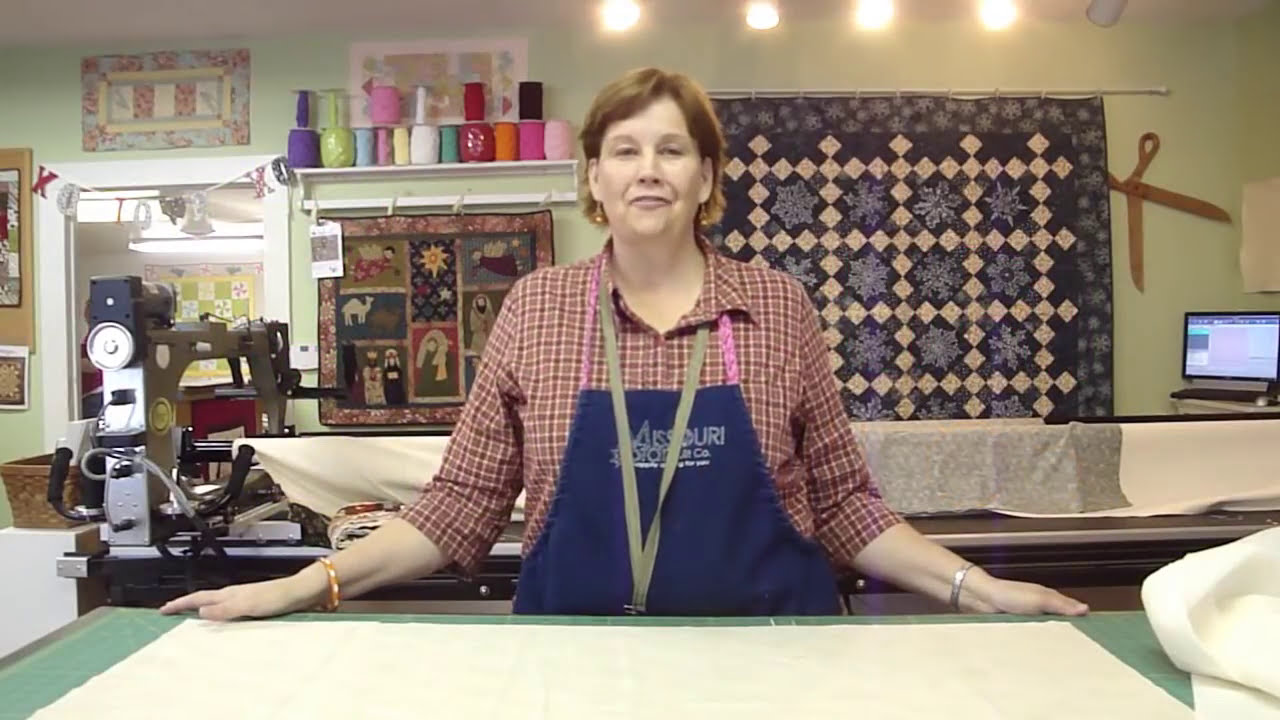
Step 1: Prepare Your Base Layers
Start by cutting your backing fabric to the size of your finished project. For the table runner Jenny demonstrates, that's about 14" × 40". Cut a piece of batting the same size.
Lay the backing fabric right side down on your work surface. Place the batting on top. Smooth everything flat — it's important that these layers stay smooth throughout the process.
Step 2: Place and Anchor Your First Strip
Select your first fabric strip and lay it right side up along the top edge of your batting. Line it up carefully with the top edge.
Take this to the sewing machine and sew along the top edge to anchor the strip to the batting and backing. This initial stitch holds everything in place for the rest of the project.

Jenny layers the first strip onto the batting and backing — the foundation of QAYG!
Step 3: Add Strips One at a Time

Now here's where the magic happens. Take your next strip and place it face down on top of the first strip, right sides together. Line up the raw edges and pin in place.
Sew along the edge with a ¼" seam — you're sewing through the new strip, the first strip, the batting, AND the backing all at once. That's the whole secret of Quilt As You Go!
Flip the new strip open and press it flat. Make sure the backing stays smooth underneath. Then repeat: lay the next strip face down, sew, flip, and press.
Step 4: Pin More as You Go
As your project grows and you add more strips, you'll want to pin more generously. The further you get from that first anchored strip, the more the layers can shift. A few extra pins prevent puckers and keep everything aligned.
After sewing each strip, always check the back of your project to make sure the backing is still lying flat and smooth. This is the most important quality check in QAYG
Step 5: Anchor the Last Strip
When you reach the bottom edge with your final strip, sew it down just like you did the first one — sew along the bottom edge to anchor it to all three layers. This gives you a clean, finished bottom edge.
Step 6: Square Up and Trim
Take your project to the cutting mat. Using your quilting ruler, line up the ruler along your sewn stitch lines to make sure you're cutting straight. Trim all four sides so the edges are clean and even.
Step 7: Bind the Edges
Your project is already quilted — now all you need is binding! Cut 2½" binding strips from your coordinating fabric, join them end to end, fold in half lengthwise, and attach them just as you would for any quilt.
Since the project is already quilted through all layers, binding goes on quickly and easily. Sew the binding to the front, fold it to the back, and hand-stitch or machine-stitch to finish.

Pro Tips for Success
📏 Vary your strip widths: Cut strips in different widths — 1½", 2", 2½", 3" — for a more interesting, organic look. The variety is what makes QAYG projects look so charming.
✂️ Cut strips slightly longer: Make your strips about an inch longer than needed on each end. You can always trim later, but you can't add length once sewn.
🔄 Check the back often: Flip your project over every 2-3 strips to make sure the backing is smooth. Catching a pucker early is much easier than fixing it after 10 more strips.
🪡 Use a walking foot: As the layers build up, a walking foot helps feed everything evenly through the machine.
📐 Scale it up: Once you master the technique on a table runner, try a lap quilt! Make multiple QAYG panels and join them together for a larger project.