



How to Make a Temperature Quilt (With Our Free Planner)
⚡ Quick Answer
- What it is: a quilt that records a year of weather, one block (or half-block) per day, colored by that day's temperature
- Plan it free: our Temperature Quilt planner pulls actual daily highs and lows for any U.S. ZIP code and year from 2001 to 2025, and matches every temperature band to a Kona Cotton solid
- How many colors: 5° per color is the sweet spot — our Hamilton, MO 2024 quilt came out to 24 Kona colors
- How much fabric: for a 3" high-and-low block, plan on roughly 30 quarter-yard cuts (about 7½ yards) for the top
- Finished size: 366 days plus 12-month marker blocks fits a 21 × 18 grid — a 63" × 54" throw with 3" blocks
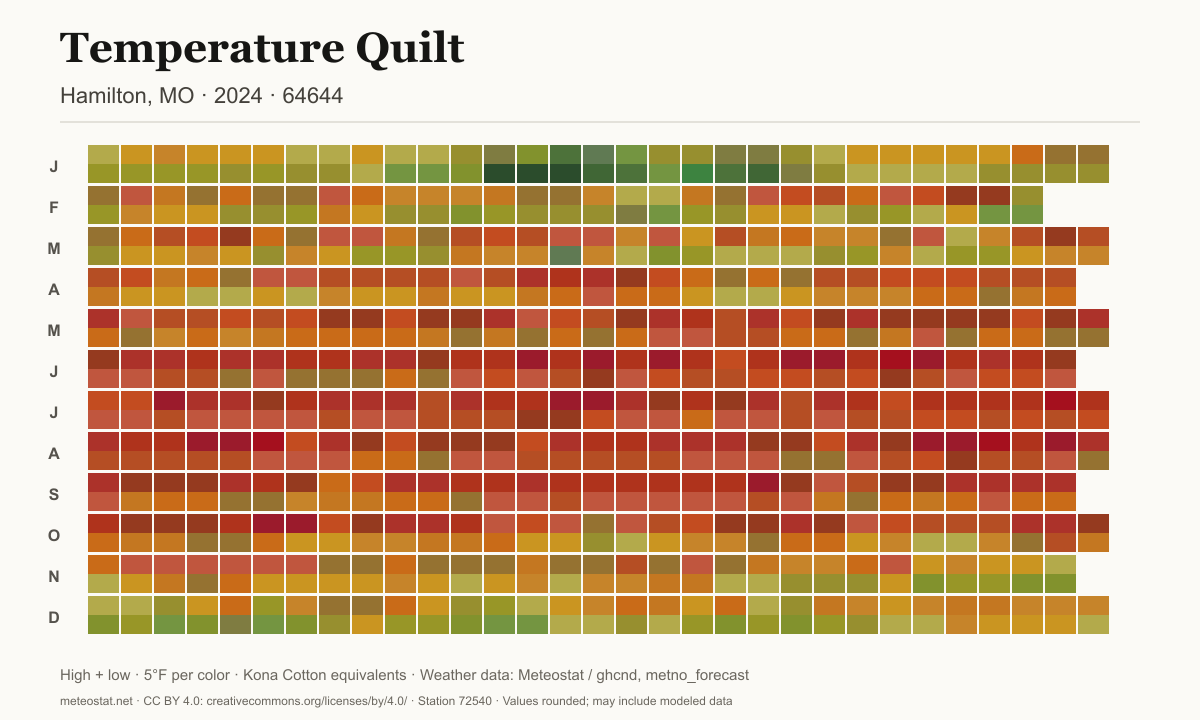
Our Hamilton, Missouri 2024 plan, shown in a warmer color story.
Every quilter we know has a year they'd like to remember — the year a grandbaby arrived, the year you retired, the year the whole family finally made it home for the holidays. A temperature quilt turns that year into fabric. Each day gets a color based on how hot or cold it was, and when you step back, the seasons appear on their own: deep blues in January, a slow green spring, a blaze of orange in July.
The hard part has always been the planning. Somebody has to look up 365 days of weather, build a color key, match it to real fabric, and count how many pieces of each color to cut. So we built a tool that does all of that: the Temperature Quilt planner is free from our very own Missouri Star Quilt Co. Labs, and it hands you a finished plan — every day, every color, every Kona Cotton code — in about the time it takes to thread your machine.
Key Takeaways
- ➤Pick a year that means something. The planner covers any completed year from 2001 through 2025, so a birth year, wedding year, or graduation year all work.
- ➤Use high + low for the most story. Splitting each block into a high half and a low half shows the swing of every day, not just its peak.
- ➤5° per color is the sweet spot. Enough colors to show the seasons, few enough that you aren't managing 60 fabrics.
- ➤Buy by strips, not by area. Every color has leftover strip ends, and quarter-yard cuts are the smallest you can buy — plan for that before you shop.
- ➤Add 12-month markers and the math works. 366 days + 12 marker blocks = 378 blocks, which is exactly a 21 × 18 grid.
What Is a Temperature Quilt?
A temperature quilt is a weather diary in cotton. You choose a place and a year, assign a fabric color to each temperature range (say, one color for 50–54°, the next for 55–59°), then make one block per day in that day's color. Sew them in order, and you get a one-of-a-kind picture of a place and time — nobody else's quilt will ever match yours, because nobody else lived your year in your ZIP code.
Knitters and crocheters have made temperature blankets for years, one row a day. Quilters have an advantage: we can put both the high and the low in the same block, and solids make the color changes crisp and graphic.
We Ran Our Own Hometown First: Hamilton, Missouri, 2024
Before we told anyone about the planner, we pointed it at home. Here's what Hamilton's 2024 looked like, straight out of the tool:
| What the planner found | Hamilton, MO · 2024 |
|---|---|
| Days in the quilt | 366 — 2024 was a leap year, so you get a bonus February block |
| Coldest reading | −17° on January 14, in the middle of a week-long arctic blast (the high on January 15 never got above −7°) |
| Hottest day | 97° on June 25 |
| Wildest swing | February 28 hit a high of 76°; the next day's high was 29° — a 47° drop you can see in the quilt as a gold block sitting right next to a green one |
| Days that topped 90° | 21 |
| Kona colors at 5° per color | 24, from Regal (−20° to −16°) up to Canada Red (95° to 99°) |
| Weather station used | Spickard, about 38 miles away — the planner tells you which station it used and how many days were filled in with modeled values |
Two things surprised us. First, how much of a north Missouri year falls between 25° and 65°? With the default Classic spectrum color story, green sits in the middle of the scale, so our quilt came out mostly green, with blue and red reserved for the extremes. If you'd rather see winter look like winter, pick a color story that leans more toward the cold end, with more blues and purples. Second, how visible the weather events are. That January cold snap is a run of the darkest blues and purples on the scale, and you can spot it from across the room.
💡 Pro Tip: Every place has its own look. Run your ZIP code in two or three different years before you commit — one year may give you a dramatic cold snap or a record heat wave that makes a better quilt.
How to Plan Your Temperature Quilt, Step by Step
Open the Temperature Quilt planner and work down the settings in order. Each choice changes how the finished quilt looks and how much fabric it takes.
| Setting | Your options | What it changes | Our pick |
|---|---|---|---|
| ZIP code + year | Any U.S. ZIP · 2001–2025 | Whose weather, and which year of it | The year you want to remember |
| Temperature | °F or °C | The scale the color key is built on | °F |
| Daily reading | High + low, high only, low only | High + low splits each block into two halves; high or low only gives one solid block per day | High + low |
| Time period | Days or weeks | Days = 365 or 366 blocks. Weeks = 52 averaged blocks, a much smaller and faster quilt | Days |
| Degrees per color | 1° to 10° | Smaller steps = more colors and more subtle shading; bigger steps = fewer, bolder colors | 5° |
| Block size | 2", 3" or 4" | Finished size of the quilt and how much fabric you need | 3" |
| Color story | 15 palettes, or pick your own cold, middle and hot colors | The mood of the quilt; the planner finds the closest Kona Cotton for every band | Try several |
When the preview looks right, switch between the three tabs. Quilt Preview shows the whole year laid out by month. Daily List gives you each date with its high, low, and exact fabric — this is the list you'll sew from. Fabric List totals the pieces for each Kona color. Then export: a PNG to hang by your cutting table, a PDF to keep, or a CSV to check off in a spreadsheet as you go.
💡 Pro Tip: Use Edit legend to swap any color you don't love for a different Kona shade. Screens aren't perfect at showing solids, so if you can, compare against real fabric before you cut.
How Much Fabric Does a Temperature Quilt Take?
Here is where most temperature quilt plans go wrong. Add up the area of 366 little blocks and it looks like you barely need any fabric at all. But you don't cut blocks out of thin air — you cut them from strips, and every color leaves a strip end behind.
For a 3" finished high-and-low block, each half is cut 3½" × 2". From one 2" strip, cut across the width of the fabric, you'll get 12 pieces. So:
| Block size (finished) | Cut each half | Strip width | Pieces per strip |
|---|---|---|---|
| 2" | 2½" × 1½" | 1½" | 16 |
| 3" | 3½" × 2" | 2" | 12 |
| 4" | 4½" × 2½" | 2½" | 9 |
Take the piece count for each color from the Fabric List tab, divide by the pieces per strip, round up, and that's your number of strips. Our Hamilton quilt needed 7 strips of its most-used color (Grass Green, 73 pieces) and a single strip of Deep Blue for the one day that dipped that low. Cut exactly, the whole top uses a little over 4 yards. But since a quarter yard is the smallest cut you can buy, and even Deep Blue needs one, the shopping list comes to about 30 quarter-yard cuts, or 7½ yards across all 24 colors.
💡 Pro Tip: The rare colors are the ones that sell out on you. A hot-end red or a deep-freeze navy might only appear on two or three days, so buy those first. Everything is sold by the quarter yard in our Kona Cotton Solids, which makes a 24-color quilt easy to gather.
Laying Out 366 Days: Three Ways to Arrange It
The planner previews your year as 12 rows, one per month. That's the easiest way to read it, but it isn't the only way to sew it.
| Layout | Grid | Size with 2" blocks | Size with 3" blocks | Size with 4" blocks |
|---|---|---|---|---|
| Month rows (like the preview) | 31 across × 12 rows | 62" × 24" | 93" × 36" | 124" × 48" |
| Grid with 12 month markers | 21 × 18 = 378 blocks | 42" × 36" | 63" × 54" | 84" × 72" |
| Weekly averages | 52 or 53 blocks | Small wall hanging or runner | Small wall hanging or runner | Table runner |
Month rows read like a calendar, but they come out long and narrow — a bed runner or a big wall piece. Short months leave gaps; fill them with a neutral like Kona Snow or Kona Coal, and add sashing between months if you want each one to stand on its own.
The 21 × 18 grid is our favorite. Put one neutral "month marker" block before each month starts and a leap year fits exactly: 366 days + 12 markers = 378 = 21 × 18. In a 365-day year you have one spare block, which is the perfect spot for an embroidered label with the place and year. With 3" blocks, it's a 63" × 54" throw before borders.
Weekly mode averages all data from each week into a single block. It's a great first temperature quilt if a whole year of daily blocks feels like a lot.
💡 Pro Tip: Want a diagonal split instead of a top-and-bottom one? Make each day a half-square triangle with the high on one side and the low on the other. Our half-square triangle basics tutorial walks you through it. Cut your squares a little bigger than the finished size to allow for the diagonal seam.
See How Different a Year Looks in Different Places
Every one of these was made with the planner from real historical highs and lows. Same tool, same kind of block, completely different quilts.
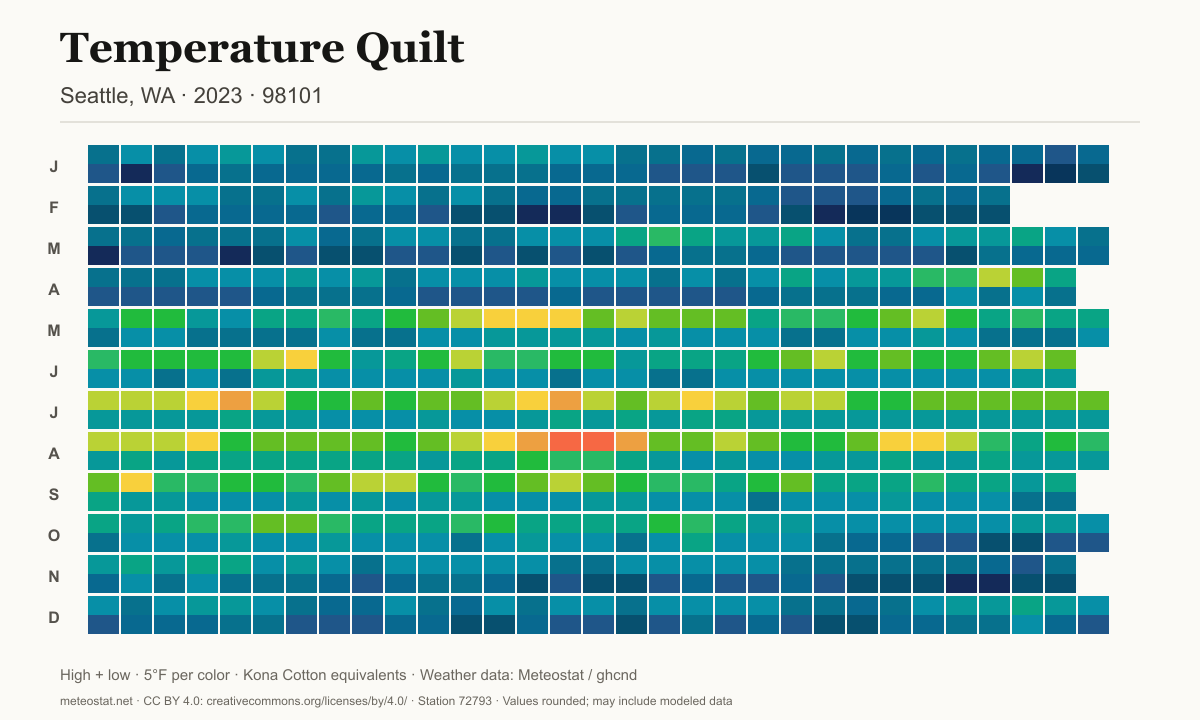
Mild and even
Seattle, WA · 2023
A narrow temperature range means cool teals nearly all year, with just a few warm summer days.
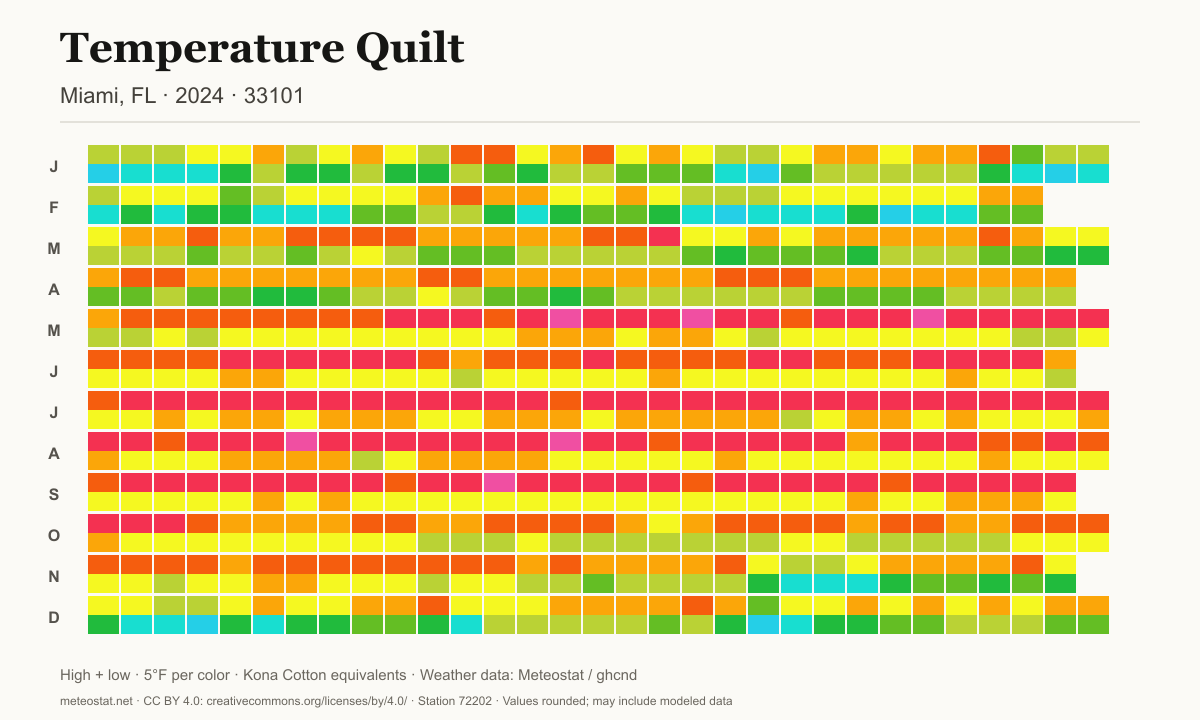
Hot all year
Miami, FL · 2024
Barely a cold day in the whole year, so the palette runs sunny from January to December.
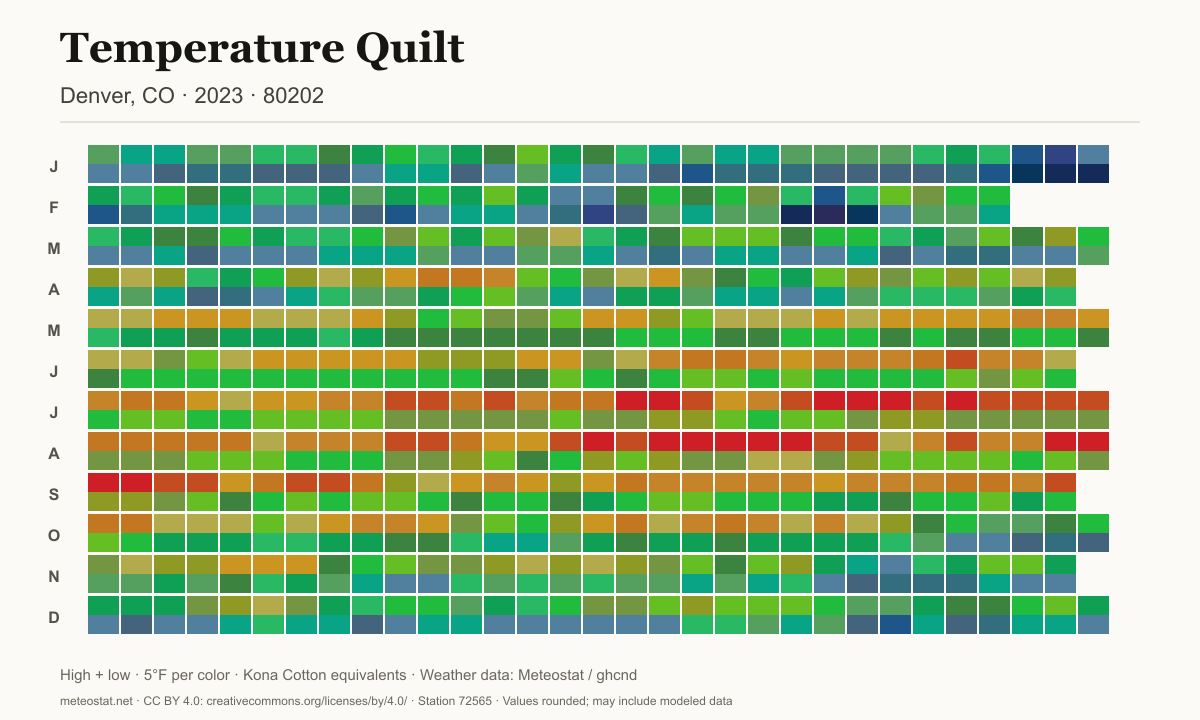
Big daily swings
Denver, CO · 2023
Mountain weather means warm afternoons and cold nights, and the high + low split makes that easy to see.
Finishing Your Temperature Quilt
The planner covers the top. For the 63" × 54" grid quilt, you'll also want:
- Backing: about 4 yards of 42" fabric pieced with one seam, or about 1¾ yards of 108" wide backing. Our backing yardage guide shows the math.
- Binding: seven 2½" strips, so ½ yard. A binding in your coldest or hottest color frames the year nicely. See how to figure binding yardage.
- Batting: a throw-size piece from our quilt batting selection.
- A label: write down the place, the year and the station the planner used. In 30 years someone will want to know.
Frequently Asked Questions
What is a temperature quilt?
A quilt that records the weather for a place over a year. Each day (or week) becomes a block colored by that day's temperature, so the finished quilt shows the seasons changing.
Is the Temperature Quilt planner free?
Yes. The Temperature Quilt planner is free to use. Enter a ZIP code and year, and you can export your plan as a PNG, PDF or CSV.
Can I make a temperature quilt for this year?
The planner uses completed years with full weather records (2001–2025). If you want to sew along with the current year, plan your palette from last year's range for the same ZIP code, then fill in each day as it happens.
How many colors do I need for a temperature quilt?
It depends on your climate and your step size. At 5° per color, our test runs came out to 20 colors for Denver 2023 and 24 for Hamilton, Missouri 2024. Milder climates need fewer. Use 10° steps for a bolder quilt with about half as many colors.
Should I use the high, the low, or both?
Both, if you can. A split block shows the daily swing, and it's the most interesting version to look at. High only or low only makes one solid block per day and is quicker to sew.
How much fabric do I need for a temperature quilt?
For a daily high-and-low quilt with 3" blocks, plan on roughly 30 quarter-yard cuts, or about 7½ yards, for the top. Buy by strips: divide each color's piece count by the pieces you get from one strip and round up.
What fabric is best for a temperature quilt?
Solids. They make every temperature band read clearly, and Kona Cotton's big range of shades means there's a close match for every step on your scale. That's why the planner matches to Kona.